
Now that year 2024 has come, I want to briefly discuss the year 2023 around the development blog, and the outlook for 2024 here. (more…)
Custom string literals: two EasyHacks
In the previous part of the series on C/C++ strings, I described the string literal, plus how and why to use them. Then I introduced the new custom string literals and their benefits: (more…)
LibreOffice extensions with Python – part 2: Debugging
In my previous blog post on creating LibreOffice extensions with Python, I have discussed how to write a Python code that works with LibreOffice API, and can be run and debugged in an IDE, and packed later in an extension. Now I discuss how to debug the Python code. (more…)
LibreOffice extensions with Python – part 1
Ever wondered how to create a LibreOffice extension? Here I discuss how to do that via Python programming language. It is possible to run and debug the resulting Python code in an IDE, and then package the content as an extension. (more…)
String literals: C/C++ string data types part 2
In the first part of the series on string types in LibreOffice, I discussed some of the string data types that are in use in various places of the LibreOffice code. I discussed various character and string data types briefly: OString, OUString, char/char*, sal_Unicode, sal_Unicode*, rtl_String, rtl_uString and also std::string. Now I want to explain string literals. (more…)
Integer data types improvement – EasyHack
Many different data types are used in LibreOffice code. During the long history of the LibreOffice, and before that in OpenOffice, there were integer data types that are no longer in use today. The task I discuss here is to choose appropriate data types to use instead of sal_uLong and similar deprecated integer data types. (more…)
UNO API error reporting improvement – EasyHack
In this blog post, I discuss the EayHack for improving UNO API error reporting. EasyHacks are good if you want to become familiar with LibreOffice programming, and this specific task is a good choice for beginners as it is a difficultyBeginner task. (more…)
LibreOffice conference 2023 workshop presentation slides
LibreOffice conference (LibOCon) 2023 was held in Bucharest from 20 to 23 September 2023. Among the other programs, an important part was the workshop “Introduction to LibreOffice Development”. Here you will find the slides for the presentations. (more…)
Catalog and schema support for SQL functions – difficulty interesting EasyHack
LibreOffice has a database application called Base. It can connect to various database management systems, and is integrated with two internal database engines: Firebird and HSQLDB. Here I discuss how to add catalog and schema support for SQL functions in LibreOffice Base. (more…)
Warning for low disk space – difficulty interesting EasyHack
Without enough space, one may face data corruption, which is really a terrible thing that can possibly happen for someones important data. In order to avoid falling into such a situation, it is good idea to give warning to the users in advance.
Code Pointers for generating warning for low disk space
To implement such a feature in LibreOffice, first place to look is this file sfx2/source/doc/sfxbasemodel.cxx.
The method to query the free space method should be added to the sal/osl folder in LibreOffice core source code. To add OS specific code, one may use unx and w32 folders inside it.
Please note that LibreOffice needs to know the disk space on different devices, so passing a vector containing path and free disk space is a good suggestion here.
You should know that guessing the required disk space to save the file is not easy. So, the idea is to have several megabytes free to avoid facing problems. That is in cases the file is not actually very huge. It is possible to add that limit as an option, placed in Tools > Options. These days, even 100-200 megabyte is not that much when comparing it to the very fast disk consumption by different applications like browsers and other similar huge software that people use regularly.
Another nice feature to implement is a handler that runs with low priority every several seconds and checks the available temporary space. That will help avoiding problems with saving images in that specifc temp directory.
Testing the Warning for Low Disk Space
One needs to create a test environment to actually test the patch in action. Using a small RAM drive, it is possible to do that. These commands are useful to create a 20 MB partition for testing:
mkdir /tmp/small
sudo /bin/mount -t tmpfs -o size=20m,mode=0700,uid=$USER,gid=$GROUP /dev/shm /tmp/small
After invoking the above instructions and filling the disk space, you can invoke LibreOffice with the below command to use temp drive. As a result, you will get the below error message:
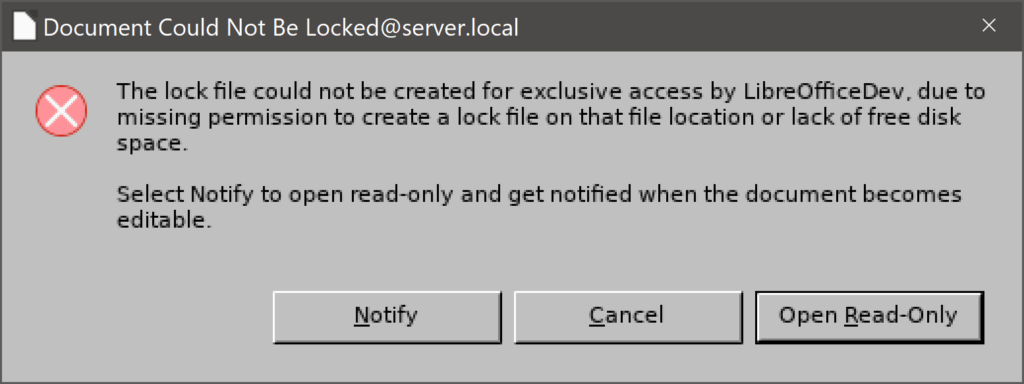
But, no warning message is shown when you have some small disk space which is < 1 MB.
$ instdir/program/soffice -env:SAL_USE_VCLPLUGIN=gen -env:UserInstallation=file:///tmp/small /tmp/small/1.pptx
While having < 1 MB disk space, you will get this warning in the terminal, but not when the space is between 1 and 2 MBs.
warn:configmgr:57868:58063:configmgr/source/components.cxx:190: error writing modifications com.sun.star.uno.RuntimeException message: "cannot write to file:///tmp/small/user/nnePqE at ~/Projects/libreoffice/core/configmgr/source/writemodfile.cxx:109"
Please note that both the profile and the opened file were inside /tmp/small.
Final Words
The above issue is tdf#60909. If you like it, just follow the Bugzilla link to see more information.
To implement this feature, first you have to build LibreOffice from the sources. If you have not done that yet, please refer to this guide first: